And here is the promised link to the complete New York Times article.
Learn the business English you need to succeed at work. Stay on top of the latest workplace vocabulary -- idioms, expressions, words and more! All the English you need ... but won't find in a textbook!
Wednesday, October 24, 2012
Office English: What to Call the Assistant
And here is the promised link to the complete New York Times article.
Tuesday, September 18, 2012
The Workplace "Whiner" - and Some Useful Business English
The Wall Street Journal ran an article recently called "What to Do With A Workplace Whiner." Let's read some of that article and then discuss the expressions and terms used (these are in bold below). Add these expressions to your business English vocabulary. They are sure to come in handy!
-----------------------
Here we go with our vocabulary study:
office politics - the little games people in offices play to try to get ahead (get more money, get a promotion, get a better job, get more power, get better treatment, etc).
cubicle farm - an office with cubicles (note: this term has a negative feel to it). This is often shortened to cube farm.
backfire - to bring about the opposite result of what was intended. Example: Our complaints about having the holiday party at our boss' house backfired. Instead of holding the party at a restaurant instead, the company just canceled the party.
self-righteous - always sure that one is right (and often being intolerant of others' points of view). This is definitely NOT something you want to be called!
(to) take something the wrong way - to understand or interpret something as insulting; to be offended by what someone says (often because you are not understanding it as the speaker intended). Example: Don't take this the wrong way, but I think it's time you start looking for another job.
(to) alienate - to make others hostile towards you; to push others from you by things you say or do. Example: Joe has alienated his entire staff with his bossy behavior.
(to) gripe - to complain; to whine (note: this term has been around for centuries -- it comes from the Old English term: gripan). Example: Please stop griping about working long hours. Everybody else is also working hard these days.
in a slump - a slow period; a recession (Note: this has a second meaning -- when one is feeling down or depressed, you can say he's or she's in a slump).
(to) stay upbeat - to remain positive. Example: Sales have been slow lately, but we're trying to stay update.
arduous - difficult; hard to achieve
If you like this post, be sure to sign up as a follower of this blog and also as a Twitter follower. That way, you'll be the first to know when we've got new content on here! And you won't have to gripe that you're the last to find out!
Friday, September 7, 2012
Back to School with some Business English
Here we go with the part of the article we will analyze. Target vocabulary is in bold:
Getting into B-School On Your Boss's Dime
Companies are advertising a rather peculiar perk to lure top undergraduate talent: Showing them the door—to graduate school, that is.
As a means of attracting stellar young hires, an increasing number of firms in finance, consulting and technology are shepherding employees through the graduate-school admissions process by organizing and paying for test-preparation courses, inviting admissions consultants to help with applications, arranging mock interviews with senior staffers and even bringing school representatives to information sessions at the office...
It may seem counterintuitive to encourage employees to head for the exits, but firms say that assisting with the graduate-school application process leads to long-term loyalty and, with strings attached to tuition money, improves the chances that employees will return after graduation...
Such programs have been in place for a while, but have grown more popular in recent years as the recruiting process heats up.
----
Here we go with explanations of the vocabulary in bold:
on one's dime - paid for by someone else (usually by one's employer). Example: We all went out for sushi today, on the company's dime.
perk - a benefit given to employees (such as bonus money, a gym membership, free tuition for school, etc).
(to) lure - to attract (note: this is one of the verbs featured in our ESL app "Business English Power Verbs" available on iTunes for iPad and iPhone - check it out here.
(to) show someone the door - to fire an employee or to encourage an employee to leave the company (in this article, this expression is used with a twist - not firing an employee but rather encouraging them to go in the door of graduate school (so here we have a play on words)
stellar - excellent; the best
staffers - people who work at a company (note: a cooler way of saying "employees")
(to) head for the exits - to leave (often employees will "head for the exits" if there is a problem with the company). Note that the verb "to head" on its own means to leave for a destination, as in: "It's 5 o'clock? I'd better head home now."
with string attached - with conditions (note: you will more often here the expression "with no strings attached" meaning an offer or deal with no hidden conditions)
(to) heat up - to become more intense or active
Want to learn more Business English? Check out the book & CD Speak Better Business English and Make More Money.
Thursday, June 7, 2012
American Business English - Learn How to Name Your Colleagues!
A Short Field Guide to American Workers (Part One)
![]() |
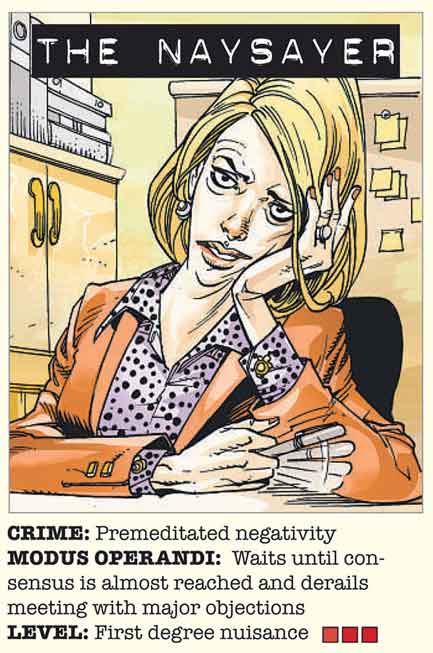
| The "Naysayer" - image courtesy of the Wall Street Journal |
The naysayer - the person who thinks nothing is ever possible ... ever. The one who is quick with the reasons why something will not work -- without have any creative suggestions for how to solve a problem. Favorite sentence starters for the naysayer:
- "That won't work because ..."
- "We tried that a few years ago and ..."
- "There's just one thing ..."
- "No, that'll never fly." (note: "fly" = work)
The nitpicker - the person who finds fault or problems with everything. The reason they find problems with everything is that they look hard for them! No problem is too small to identify and complain about! This word is featured in the book Speak Better Business English and Make More Money. Its origin comes from picking nits out of hair or fur (nits are the little eggs of parasitic insects).
![]() |
| The "Rambler" - image courtesy off the Wall Street Journal |
The control freak - this person spends every moment trying to control everybody else. How do they get their own work done? They don't. They think of it as their job to control what you and everybody else is doing. Think you're going to make a quick trip to the bathroom without anybody noticing? Think again!
The micro-manager - a relative of the nitpicker (see above). No tiny detail is too small for this person to worry about. She'll spend hours re-ordering the lists in your PowerPoint. He or she manages every single detail. The people working for her/him will often start to feel dumb, powerless, and resentful. But most micro-managers won't pick up on those feelings.
The bad apple - this is the person in the office who never should have been offered a job. Sometimes he or she is also called the "rotten apple." They create trouble everywhere. They talk behind people's backs and stir up trouble. They are the basis for the proverb: "One bad apple can spoil the whole bunch." In other words, this person can turn other people in the office -- good people -- into bad ones (by spoiling their morale, creating a bad atmosphere, etc). I don't know how such a wholesome fruit as the apple got to be part of this negative expression!
* you gotta love 'em - this American English expression means just the opposite of what you might think: you will NOT love them because they are annoying. So it is used mainly in an ironic way.
P.S. We've just learned of a company in the state of Utah, USA that sells coffee mugs based on annoying personality types! You know the old saying: "Only in America!" They've got a fine list of annoying personality types along with some funny pictures. Check it out here if you want a good laugh.
Thursday, May 31, 2012
Want to learn American slang?
Wednesday, May 9, 2012
The Favorite "Hot" American Word
The most recent Word of the Year (WOTY) is "Occupy." According to Ben Zimmer, chair of the New Words Committee of the American Dialect Society, “It’s a very old word, but over the course of just a few months it took on another life and moved in new and unexpected directions, thanks to a national and global movement.” Yes, that would be the Occupy Wall Street movement, which went from occupying Wall Street to occupying cities and town around the entire USA and onto the rest of the world. In this case, the fourth definition of occupy given by Dictionary.com is the most fitting: to take possession and control of (a place), as by military invasion. Maybe with the Occupy movement, this meaning of the word will move up a notch or two!
Lots of other great words were under consideration for the Word of the Year. Here are three of my favorites (and I encourage you to try these out):
1) humblebrag - expression of false humility, often by celebrities on Twitter (Note: "Humble" means when somebody is modest and "brag" is when you say great things about yourself -- put them together and you have false modesty). Here's a great humblebrag example I found on Urbandictionary.com: "I can't believe I sounded like such a idiot on TV last night"
2) FOMO - acronym for “Fear of Missing Out,” - as in, you might miss out on a great party if you decide to skip it. A very nice expression for the mobile phone age because it's short and easy to type and expresses just that feeling you have sometimes when you don't really feel like doing something, but you worry that you will miss something good if you don't do it.
3) artisan, artisanal - term used to describe gourmet food and other products. The folks at American Dialect Society call it a "faux-fancy" term, which I like. It's the kind of adjective you can stick in front of a loaf of bread at a Farmer's Market and then double the price. Or try it out in front of "pizza" as Domino's Pizza is doing for their new fancy "Artisan Pizza" which sells at a premium to its standard pizza. I have also run into "artisanal cheese" recently. It was really expensive, apparently because somebody lovingly made it by hand, in small batches. I think I saw small specks of mold on it too, but maybe that was supposed to add to its charm and "artisanal" quality!
"Occupy" was the Word of the Year in 2011. Of course, there is going to be another WOTY in 2012. We can only guess now at what English word or expression might rise to the top of the pile and occupy next year's place of honor!
Friday, April 6, 2012
Let's Learn Some More Business Idioms!
Microsoft Banks on Mobile Apps
Microsoft Corp., struggling to dent the dominance of Apple Inc. and Google Inc. in the smartphone market, is stepping up efforts to court app makers like Hemi Weingarten.
Last fall, Microsoft aggressively recruited Mr. Weingarten to convince him to build his nutrition app Fooducate for its Windows Phone. Microsoft proposed putting a Fooducate engineer in Tel Aviv through a weeklong boot camp, and offered a new Windows-based Nokia phone for software testing.
Yet despite the enticements, Fooducate skipped the boot camp and chose not to develop a Windows Phone app.
"We decided to focus our energies on the bigger platforms" of Apple's iPhone and Google's Android, said Mr. Weingarten, the 41-year-old chief executive of Fooducate. He said he plans to develop for Windows Phone eventually.
His experience highlights how Microsoft is actively trying to woo developers to the Windows Phone—as well as the hurdles the software maker faces in getting app makers on board.
----
Now let's discuss the vocabulary from the article:
(to) bank on - to count on; to rely on (as a way to make money). You may hear people say, "You can bank on it!" As in this example: "Boss, do you think I'll get a promotion this year?" -- "You can bank on it!"
(to) step up efforts - to increase efforts; to try harder at something (Yes, you can be sure that Microsoft is stepping up its efforts in the app market - Apple is making a killing in this market! Make a killing means make lots and lots of money).
boot camp - an intensive training program. This expression comes from the military, where it means a training camp for military recruits. (Let's hope the participants in Microsoft's boot camp had more fun than people in a military boot camp -- at least they were probably served better food!).
(to) focus our energies on - to focus on; to devote resources to (In this case, savvy Mr. Weingarten of Fooducate has decided to "focus his energies on" developing apps for the iTunes and Android marketplaces -- and no wonder, they are huge. To tell you the truth, I didn't even know Microsoft had an apps marketplace until I read this Wall Street Journal article!).
woo - to try to win the favor of; to seek the support of. This verb has a second meaning: to gain the love of (usually a woman), for the purpose of marriage
to face hurdles - to deal with obstacles or problems (hurdles are problems you have to solve before you can do something). This handy little idiom also made the headlines of Wired Magazine recently: Google Glasses Face Serious Hurdles, Augmented-Reality Experts Say.
(to) get someone on board - to get someone to join or agree to something; to go along with something. (On board also means when you're on some form of transportation - like on board a bus, on board a train, on board a plane -- so to help you remember this, picture yourself on a plane with a group of business people, having a great talk, all of you in agreement with each other!).
Want to learn more useful business English? Check out our books and audio CDs, the
bestselling Speak Business English Like an American and Speak Better Business English and Make More Money.