Showing posts with label learn English. Show all posts

Tuesday, August 5, 2014

Learn Business English with Some News on Facebook

Today we're looking at an article about Facebook from the New York Times. As you may have heard, Facebook is making more and more money by selling ads on its site. In this article, we learn of a company finding success selling fish oil through Facebook. The words and idioms we'll focus on are highlighted in blue:
The idea was to come up with a big, sweeping campaign to market MegaRed, a premium alternative to fish oil pills, to users of the social network. Each ad had to be so compelling that it would get people to stop scrolling through their news feeds ...
But from where Mr. Rodrigues sat, as the guy who would write the checks for the proposed campaign, the Facebook people seemed to be missing an essential point. 
The advantage of advertising on the world’s largest social network was that it could do something television ads could not: Using sophisticated analytics, it could help him find people who were already buying fish oil or other products that suggested they were concerned about the health of their hearts, and perhaps persuade them to switch to his brand.
At the meeting, the company’s ad strategists were saying they wanted him to spend money to show ads to every American woman 45 and older on Facebook. Finally, with some exasperation, Mr. Rodrigues — the marketing director for vitamins, minerals and supplements at Reckitt Benckiser, the company that owns MegaRed — blurted out what he’d been thinking. For that kind of broad blitz, he said, “I can go to television at a quarter the price.”

Now let's look at the highlighted words and phrases:

compelling - attracting interest; very interesting and appealing

missing [the] point  - not understanding the problem; focusing on the wrong thing

exasperation - annoyance; intense irritation

to blurt out - to say suddenly or without thinking; to say something sensitive that nobody is expecting you to say

blitz - an advertising campaign (often a large one). Note: this is from the military, meaning a campaign in which bombs are dropped from airplanes

I hope you enjoyed this short Business English lesson! If you're looking for more Business English, please check out the new app Business English Negotiations for iPhone and iPad: http://bit.ly/UNaSCQ

Tuesday, February 26, 2013

Let's Learn Some Business English with a Story about Jesus (the Brand)

An advertisement for Jesus Jeans
(It looks like this model could have 

gone for the next size up!).
No, this is not going to be a post about religion. It's going to be a post to help you improve your Business English (and your legal English). But we are going to be talking about Jesus today. That's because an Italian clothing company has trademarked the name "Jesus" and uses it on its Jesus Jeans. It's now fighting with other clothing companies trying to use the name Jesus too.

In conversational English we sometimes say "Jesus!" to express anger or outrage (or the shortened "Jeez!"). Some of the people in the newspaper article we are going to look at today are definitely saying "Jesus!" They are very unhappy that one company is not sharing the "Jesus" name. Who would have though that dozens of clothing companies would choose "Jesus" as their brand name? And then start fighting about it? All of this is not in the spirit of Jesus himself, but it does make for interesting reading (and English study!).

Let's take a look at the newspaper article, which is entitled "If You Take These Jeans' Name in Vain, Prepare to Meet Their Maker" and is from the Wall Street Journal. The expressions we will study are in blue.

Inspired by his time leading a singles ministry in Virginia Beach, Va., Michael Julius Anton came up with an idea for a clothing line that he thought was catchy and unique—"Jesus Surfed." He was on good ground with "Surfed." But when he went to register the trademark, he found someone had beaten him to Jesus.
In a branding coup of biblical proportions, an Italian jeans maker persuaded the U.S. Patent and Trademark Office in 2007 to register the word "Jesus" as a trademark, giving the company exclusive rights in America to sell clothing bearing the name of Christianity's central figure.
Since then, the owner of the trademark, Jesus Jeans, has clamped down on Jesus-themed apparel, pitting its litigators against more than a dozen other startup clothing lines it claims appropriated "Jesus" without the company's blessing. The company doesn't have a trademark on images of Jesus, just the word.
Before taking on Jesus Surfed, Jesus Jeans objected to "Jesus First," "Sweet Jesus," and "Jesus Couture," among others, which abandoned their trademark efforts. In some cases, when met with resistance, Jesus Jeans warned that it could sue for damages.
Now let's look at the definitions of vocabulary:

(to) come up with – to think of

catchy – memorable, appealing (Note: You will often heard the phrase "catchy tune," meaning a song or melody that stays in your head and is fun to sing, though eventually it might drive you crazy)

on good ground – safe with (Note: this terms first appeared in the Bible, which is probably why the author of this newspaper article chose to use it in a story about Jesus: Here is a quote from Luke 8:15, King James Bible: But that on the good ground are they, which in an honest and good heart, having heard the word, keep it, and bring forth fruit with patience.)

(to) register a trademark – to formally register a symbol (name, logo, etc) for a product with a governmental patent office (in the USA, with the United States Patent and Trademark Office, USPTO)

(to) beaten someone to – to do something before somebody else has a chance (in this case, Jesus Jeans beat Jesus Surfed to register the "Jesus" trademark)

of biblical proportions – great; having big consequences; large in scope (Note: This often refers to natural disasters -- Example: A wildfire of biblical proportions swept through California and destroyed hundreds of houses). Biblical is the adjective form of Bible, so here we have a play on words.

(to) clamp down on – to get strict about

(to) pit someone against – to put someone up to fighting someone or something

blessing – two definitions (which is what makes this word choice another play on words here): 1) approval and 2) a favor or gift bestowed by God (Note: there are some other definitions of this word also)

(to) meet with resistance – to face one's objections to something 

(to) sue for damages – to take someone to court and try to get money (or other compensation) from them for harming one's business

Tuesday, November 27, 2012

Study Business English with this Mini-Case Study on Starbucks

Starbucks is "rolling out" new stores
in China.
Did somebody say "coffee?" I am a huge fan of all things caffeinated -- that would be coffee, followed by tea, and let's not forgot chocolate (the darker the better and I currently working on a 90% cocoa dark chocolate bar, very delicious!). So when I opened the Wall Street Journal today and saw an article about Starbucks expanding into China, I decided to grab a cup of coffee and turn the story into a short business English lesson for this Blog's 12 official followers (thank you, loyal readers!) and the hundreds of others who visit this blog to improve their business English.

The article is entitled, "Starbucks Plays to Local Chinese Tastes." Here's the piece of the article we will expore, with the target vocabulary highlighted in blue:

After nearly 14 years of working to persuade China to buy into its foreign coffee culture, Starbucks Corp. is aiming to become more Chinese as it plans a rapid expansion in the country. Belinda Wong, president of Starbucks China, said in an interview that Starbucks aims to roll out 800 new stores in the next three years to add to its existing fleet of 700...
The company aims to capture a larger market by going more local and applying its cultural insights, Ms. Wong said. For instance, whereas kiosk-sized stores work well in the U.S., where office workers grab bacon-gouda sandwiches to go in the morning on the way to work, Starbucks has learned that Chinese consumers value space and couches on which to relax in the afternoons.
The coffee company is adding some stores that are nearly 3,800 square feet and can seat consumers who come with groups of friends and business partners. Starbucks also has discovered that Chinese tastes for coffee go only so far. It plans to introduce new Chinese-inspired flavors, building on existing favorites like red bean frappuccinos …

Businesses that have failed to grasp the local culture, importing alien models, have fallen out of favor. In September, Home Depot Inc. closed all seven of its remaining big-box stores in China after years of losses, having discovered that the do-it-yourself home improvement model doesn't work well in a do-it-for-me Chinese culture.

Now let's look at the vocabulary highlighted in blue:

(to) roll out - to introduce (often a product or service, in this case a retail store). Wow, with this "roll out," Starbucks will more than double the number of stores it has in China. And you thought there were a lot of Starbucks in Manhattan!

(to) capture a larger market - to get more customers (In this case, to get more people in China to switch to a visit from Starbucks coffee from whatever coffee house, tea house, or other place they are currently visiting).

(to) go only so far - to have limitations (In this article, it means that the Chinese customers do not have an unlimited thirst for just plain coffee. If Starbucks is going to sell them more drinks, the company needs to figure out what their tastes are and create drinks based on them -- hence the red bean frappuccion (whereas in the USA, you can get a Caramel Brulée Latte, which I am pretty sure is not on the menu at Starburcks in Shanghai!).

(to) fall out of favor - to stop being popular; to become unpopular. (In this case, they are talking about the fact that the "global strategy" is no longer as popular and effective as it used to be. With a "global strategy," companies typically treat the world as one big market and have little or no variation in products or services across the various countries).

do-it-yourself - as the word suggest "Do it Yourself!" as in, buy all the stuff you need for your home improvement project and do your own construction work -- as in, re-model your own kitchen, re-tile your own bathroom floor, or install your own new toilets. This is often abbreviated "DIY".

-----
To summarize this article, Starbucks is going to roughly double the size of its business in China. And instead of replicating what works in the United States, the company has figured out how to customize its offerings to suit the tastes of the Chinese consumer. That means drinks that appeal to them and their native cuisine (red bean frappuccinos, Hainan chicken and rice wrap) and plenty of space to hang around on a couch while drinking them. The company is also taking steps to attract non-coffee drinkers. Here's a closing quote from the article, in which we hear from an English teacher in China:

The company is aiming to cater to noncoffee drinkers like Cheng Xiaochen, a 27-year-old English teacher who hates coffee but occasionally meets his students and business partners at Starbucks in the afternoon. "It's a good place to meet people," said Mr. Cheng. "But the coffee is so bitter it tastes like Chinese medicine." Mr. Cheng said he sticks to mint hot chocolate and looks for other sweeter flavors.


Thursday, June 7, 2012

American Business English - Learn How to Name Your Colleagues!

A Short Field Guide to American Workers (Part One)

Your American colleagues and co-workers ... you gotta love 'em.*  Or not. If not, you can have lots of fun figuring out how to categorize them. Here are a few types of office workers that are universal (at least in the USA -- maybe other countries have their own typical office worker types): 

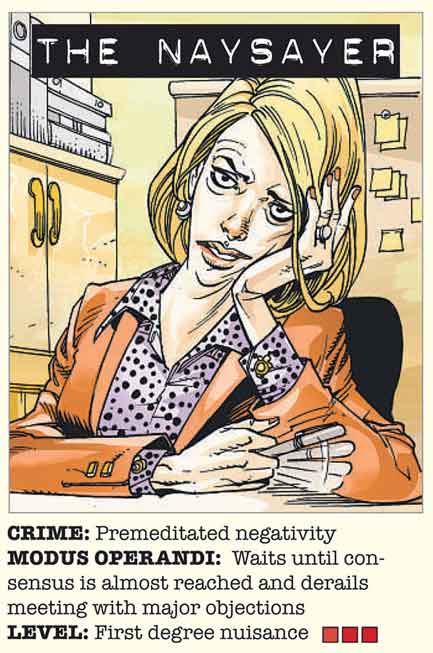
The "Naysayer" - image courtesy of the Wall Street Journal

The naysayer - the person who thinks nothing is ever possible ... ever. The one who is quick with the reasons why something will not work -- without have any creative suggestions for how to solve a problem. Favorite sentence starters for the naysayer:
- "That won't work because ..."
- "We tried that a few years ago and ..."
- "There's just one thing ..."
- "No, that'll never fly." (note: "fly" = work)

The nitpicker - the person who finds fault or problems with everything. The reason they find problems with everything is that they look hard for them! No problem is too small to identify and complain about! This word is featured in the book Speak Better Business English and Make More Money. Its origin comes from picking nits out of hair or fur (nits are the little eggs of parasitic insects).

The "Rambler" - image courtesy off the Wall Street Journal 
The rambler - this is the person in the office who does not know when to stop talking. Blah, blah, blah, as we say in American English, to express that someone is talking for too long. We can also say, "He goes on and on." This person seems to get most active when you're either trying to head out for your lunch break, or trying to leave your office by 5 p.m. Most of the information provided by the Rambler is: (a) stuff you either already know (perhaps because he's told you before, then forgot) or (b) you don't really care about. Ramblers I've known are not sensitive to small cues or body language. So they keep talking, even as you get up from your office chair and head for the door.

The control freak - this person spends every moment trying to control everybody else. How do they get their own work done? They don't. They think of it as their job to control what you and everybody else is doing. Think you're going to make a quick trip to the bathroom without anybody noticing? Think again!

The micro-manager - a relative of the nitpicker (see above). No tiny detail is too small for this person to worry about. She'll spend hours re-ordering the lists in your PowerPoint. He or she manages every single detail. The people working for her/him will often start to feel dumb, powerless, and resentful. But most micro-managers won't pick up on those feelings.

The bad apple - this is the person in the office who never should have been offered a job. Sometimes he or she is also called the "rotten apple." They create trouble everywhere. They talk behind people's backs and stir up trouble. They are the basis for the proverb: "One bad apple can spoil the whole bunch." In other words, this person can turn other people in the office -- good people -- into bad ones (by spoiling their morale, creating a bad atmosphere, etc). I don't know how such a wholesome fruit as the apple got to be part of this negative expression!

* you gotta love 'em - this American English expression means just the opposite of what you might think: you will NOT love them because they are annoying. So it is used mainly in an ironic way.

P.S. We've just learned of a company in the state of Utah, USA that sells coffee mugs based on annoying personality types! You know the old saying: "Only in America!" They've got a fine list of annoying personality types along with some funny pictures. Check it out here if you want a good laugh.


Thursday, May 31, 2012

Want to learn American slang?

The Wall Street Journal ran a great article on learning American slang in yesterday's newspaper. You can read it online here.

The article interviewed American idioms and slang expert, Amy Gillett, author of the Speak English Like an American series. Here is Amy's full list of the trickiest slang for non-native speakers to learn and her commentary on what makes this slang tricky? Have tricky slang of your own to suggest? Post it as a comment!

The top five most dangerous/hard-to-use/confusing slang words for English language learners:

What’s up? / Whassup? / Sup? – When this gets stripped down to its shortest form (‘Sup?) it can be hard to understand. It’s also hard for non-native speakers to know how to answer.  They need to learn the acceptable replies (not much, nothing much) instead of replying “fine,” “good,” or “okay.”
  
Shut up! – this term can be tricky to use and to understand because it’s meaning depends on intonation. If you say it as a standard command without a smile, it is clearly rude. If you say it with a smile and rising intonation, it could mean “I don’t believe you” or “Really? Tell me more.”  Or if you stress the “shut” and stretch it out, it could mean, “No way!” or “That’s hard to believe!”  Confusing? You betcha!

hook up  – this term can mean anything from making out to having sex. Non-native speakers are always heartened to learn that native speakers don’t really know what it means either.  Non-native speakers need to be careful not to include it in any kind of romantic overture. Invitations to native speakers along the lines of “Hey, Ashley, want to hook up?” are to be avoided.

the “f” word – this word is tempting for many non-native speakers to sprinkle into their sentences for emphasis, just like many native speakers do. But non-native speakers sometimes overuse it out of enthusiasm or use the wrong article in front of it, as in: “What a f____!” instead of “What the f____!” Non-native speakers are also more likely to put it in writing, not fully appreciating its shock value.

lego – this term, popular on college campuses, is confusing for non-native speakers hearing it for the first time. No, we’re not talking about plastic interlocking toys. It’s slang for “let’s go” and was popularized by rappers.

Friday, April 6, 2012

Let's Learn Some More Business Idioms!

Today's Wall Street Journal has an article about Microsoft trying to catch
up with Apple and Google in the apps market. Let's use this article to learn some new American English business vocabulary ... because that's what this website is all about: helping you learn more business English expressions and idioms so that you can communicate more effectively. By the way, if you like this blog, please become a follower -- and share it with a friend. So here we go with the Wall Street Journal article extract, expressions we will focus on are in BOLD:

Microsoft Banks on Mobile Apps

Microsoft Corp., struggling to dent the dominance of Apple Inc. and Google Inc. in the smartphone market, is stepping up efforts to court app makers like Hemi Weingarten.

Last fall, Microsoft aggressively recruited Mr. Weingarten to convince him to build his nutrition app Fooducate for its Windows Phone. Microsoft proposed putting a Fooducate engineer in Tel Aviv through a weeklong boot camp, and offered a new Windows-based Nokia phone for software testing.

Yet despite the enticements, Fooducate skipped the boot camp and chose not to develop a Windows Phone app.

"We decided to focus our energies on the bigger platforms" of Apple's iPhone and Google's Android, said Mr. Weingarten, the 41-year-old chief executive of Fooducate. He said he plans to develop for Windows Phone eventually.

His experience highlights how Microsoft is actively trying to woo developers to the Windows Phone—as well as the hurdles the software maker faces in getting app makers on board.

----
Now let's discuss the vocabulary from the article:

(to) bank on - to count on; to rely on (as a way to make money). You may hear people say, "You can bank on it!" As in this example: "Boss, do you think I'll get a promotion this year?" -- "You can bank on it!"

(to) step up efforts - to increase efforts; to try harder at something (Yes, you can be sure that Microsoft is stepping up its efforts in the app market - Apple is making a killing in this market! Make a killing means make lots and lots of money).

boot camp - an intensive training program. This expression comes from the military, where it means a training camp for military recruits. (Let's hope the participants in Microsoft's boot camp had more fun than people in a military boot camp -- at least they were probably served better food!).

(to) focus our energies on - to focus on; to devote resources to (In this case, savvy Mr. Weingarten of Fooducate has decided to "focus his energies on" developing apps for the iTunes and Android marketplaces -- and no wonder, they are huge. To tell you the truth, I didn't even know Microsoft had an apps marketplace until I read this Wall Street Journal article!).

woo - to try to win the favor of; to seek the support of. This verb has a second meaning: to gain the love of (usually a woman), for the purpose of marriage

to face hurdles - to deal with obstacles or problems (hurdles are problems you have to solve before you can do something). This handy little idiom also made the headlines of Wired Magazine recently: Google Glasses Face Serious Hurdles, Augmented-Reality Experts Say.

(to) get someone on board - to get someone to join or agree to something; to go along with something. (On board also means when you're on some form of transportation - like on board a bus, on board a train, on board a plane -- so to help you remember this, picture yourself on a plane with a group of business people, having a great talk, all of you in agreement with each other!).

Want to learn more useful business English? Check out our books and audio CDs, the

bestselling Speak Business English Like an American and Speak Better Business English and Make More Money.