Showing posts with label American English. Show all posts

Friday, July 10, 2020

Learn English Online: How to Make Suggestions in English

There are many ways to make suggestions in English. Here are three of the most common ones. Why don't you try them out in your next English conversation? 

1) Why don’t we / you / I + base form of the verb*


• Why don’t we stop paying our office lease and just work from home?

• Why don’t I drive you to the airport on Friday?

• Why don’t we find a new supplier for our packaging?

• Why don’t we have a Zoom chat on Thursday at 9?

* Note: The base form of the verb is the verb without any endings. Examples of verbs in the base form are: run, eat, play, go, find

2) How about + -ing form of the verb


• How about letting our employees work from home as often as they want?

• How about requiring all of our customers to wear masks?

• How about giving all of our employees a generous holiday bonus?

3) Let’s + base form of the verb


• Let’s brainstorm ideas for new products.

• Let’s work on the project tomorrow.

• Let’s wait and see what happens before hiring any new employees.

• Let’s not plan any international travel for the next year.


If you find this content useful, be sure to check out our online English courses. Register at English Academy and get the first lesson of each course free! 


Thursday, January 23, 2020

Sports Idioms: Football

Idioms are very common in daily speech. They come from a variety of sources. Some come from the military, some come from politics, others come from literature. But the top source — the one ‘hitting it out of the ballpark’ — is sports!

Sports are popular in American culture. Many American kids play sports, especially as an after-school activity. Many American adults play sports — golf is popular, as is tennis, basketball and soccer. And of course, there’s watching sports on TV, in particular ‘football’. 

Every year, over 100 million viewers tune in to the Super Bowl. This is a football game between two of the top performing teams of the year in the National Football League (NFL). One team is the winner of the American Football Conference (AFC); the other team is the winner of the National Football Conference (NFC). These two are ‘pitted against’ each other in the Super Bowl. The Super Bowl is the most watched American TV broadcast of the year. 
Non-Americans sometimes refer to this sport as “American football” to distinguish it from what Americans call soccer: in our USA football, it’s all about grabbing the ball with your hands and running with it. In soccer, it’s all about kicking the ball and making sure you keep your hands off of it.

Given this love of sports, Americans talk about sports a lot. That has led to some of this “sports talk” to carry over to our figurative language in the form of idioms. Here are a few:

Let's look at where these three football idioms came from:

1) Monday morning quarterback


The idiom comes from the fact that American football games are usually played on Sunday. On the next day — Monday — it's easy to criticize what the quarterback did wrong. The quarterback is the player is the leader of the offense. Their performance can have a significant impact on the fortunes of his team. Before each play, the quarterback tells his team which play the team will run. 

So this term is always negative. You may see it phrased as:
  • I don't mean to be a Monday morning quarterback ...
  • It's easy to be a Monday morning quarterback but ...
After a tackle, players have "piled on."

2) pile on

In football, this is when one or more players jump on top of a player after a tackle has been made. From the act of physically "piling on," comes the more figurative "piling on" of joining an argument or a verbal attack on a single person.

3) huddle up

When football players "huddle up," they gather close together to discuss a play. When managers in a company "huddle up," they meet to discuss a plan or strategy.


Thursday, May 28, 2015

Eight Business English Idioms to Discuss Success

The following is from a Wall Street Journal entitled How to Survive Being an Overnight Success. Getting quick success as an entrepreneur sounds great, doesn't it? But this article points out that there are some challenges with trying to grow too quickly. The words and idioms we will focus on are in blue.
----------
It seems like a dream scenario for a startup: Sales surge, and business takes off.
But then what?
Any number of things can turn a small business into a rapid success—from a TV appearance to great connections at a trade show to a viral online video—but sustaining that success forces an entrepreneur to make tough choices. For instance: Should the company immediately ramp up production and risk lowering product quality? Bring in more workers to help an overstressed staff, and risk destroying company culture? Try to live off the original innovation, or plow lots of cash into R&D to develop new ones that might not pan out?
How do I meet demand?
It’s the immediate problem a company must deal with when it hits the big time quickly. All of its systems are set up to handle a certain level of production and sales. And suddenly it is swamped with orders. 
----------
Here's our vocabulary for this article extract:
(to) surge - to increase quickly
(to) take off - to become popular; to turn successful
(to) ramp up - to increase
(to) live off - to make enough money from something
(to) plow lots of cash into - to invest a lot of money in
(to) pan out - to be successful
(to) hit the big time - to become very successful or popular
swamped (with) - to be overwhelmed with; to have more than one can manage

Monday, May 13, 2013

A Business English Lesson Inspired by the CEO of IBM

The Chief Executive Officer (CEO) of IBM had to tell her employees that they needed to change. So what did she do? She recorded a video message and posted it on the company blog. Her message to her 434,000 employees: you need to move faster! Of course, the video was passed on to the news media (also called "the press"). Did CEO Virginia Rometty deliver the news to her employees the right way -- or was she yelling at them as if they were children? The jury is still out (that means, people are still discussing that question!). Businessweek — a weekly business news magazine — just published an article about this. Let's look at some pieces of this article and then discuss the expressions and words in bold:

After the disappointing earnings report on April 18, Rometty released a video to all 434,000 employees in which she admitted that IBM hadn’t “transformed rapidly enough.” She called out the sales staff for missing out on several big deals. “We were too slow,” she said. “The result? It didn’t get done.” The press got wind of her message, and Rometty’s now accused of the corporate equivalent of yelling at her children in public. The Wall Street Journal, which broke the story, called the outburst a “rare companywide reprimand.” IBM declined to comment on the video ...

Employees aren’t going to watch one video or read one memo and completely change the way they work—the company has to change, too. In the video, Rometty laid out a plan for IBM to respond to customers within 24 hours: “Engage management, engage leadership, and let’s deal with it.” She’s already “reassigned” the head of IBM’s computer hardware department, the source of a large portion of the sales drop. “Ginni’s a very direct, no-BS type of CEO, and she had one message that she delivered to everyone,” [Professor Noel] Tichy says. “It would be much worse if it went through the internal channels. No one wants to hear that the CEO thinks they dropped the ball through word of mouth.”

Now let's look at the expressions and word in bold:

(to) get wind of - to find out about something, often a secret

outburst - a sudden expression of feeling (often full of emotion)

(to) lay out a plan - to present a plan

no-BS - short for no bullshit (BS means bullshit; therefore, no-BS is just the opposite!)

(to) drop the ball - to make a mistake; to fail to perform one's responsibilities

word of mouth - gossip; news spread by people talking to each other (note: often used as a marketing term to describe an advertising or marketing message that is spread from one person to another -- which is a positive thing for the company because it means that people are talking about the company's product or service).

Tuesday, April 2, 2013

Business English Greetings — and News of American Greetings

When I was growing up, I loved receiving greeting cards in the mail. My favorite greeting cards had Snoopy
on them. I would save and review them for years. So when e-cards came along and people stopped sending cards in the mail, I was not very happy. I am sure the management of American Greetings, a large greeting card company, was not so happy either!

In today's Wall Street Journal, we learn that American Greetings is saying goodbye to the stock market and taking itself private. The article is entitled "Wishing You a Fond Farewell – From the Stock Market." Let's read the beginning of the article and improve our business English. Words and expressions we'll explore are highlighted in blue and defined below:

It is an industry that thrived in the days when the printed word was king and correspondence went through the mail. But like many other businesses, it was battered by the rise of lively, innovative and often free competitors online, where stamps and handwriting aren't needed.
Welcome to the greeting-card industry, where the biggest publicly traded U.S. company in the business has decided to bid adieu to the stock market, announcing plans to go private. The Weiss family—descendants of the Polish immigrant who founded American Greetings Corp. shortly after his arrival in Cleveland in 1905—on Monday said it agreed to pay $18.20 in cash per share to remove the company from the public markets.   The greetings-card business has seen better days, and American Greetings today is worth almost 65% less than it was at its peak in 1998. Like many media companies, it was hit hard by the Internet, with customers finding new ways to share old sentiments like birthday or holiday greetings. Tech companies including Apple and Facebook launched their own electronic greetings businesses, letting their customers send physical or electronic gifts and greetings on a birthday or anniversary.

(to) thrive – to do very well; to succeed; to flourish (in this case, the greeting card industry was thriving ... back in the days when people actually sent their greetings by regular mail rather than via the Internet).

correspondence – communication by letters (in other words, people writing to each other)

battered by – hurt seriously by (Note: this can be used in the financial sense, as it is here. It can also be used in the physical sense as in: Our beach house in New Jersey was battered by Hurricane Sandy).

publicly traded company – a company that trades on the stock exchange (versus a private company that is owned by one family or group of investors)

(to) go private – to remove a company from the stock exchange, so it is once again owned by private investors. This is the reverse process of "going public" in which a company lists itself on the stock exchange. 

(to) have seen better days – to be in a period of decline or slow sales (yes, American Greetings definitely has seen better days -- 15 years ago, it was worth a lot more than it is today).

(to be) hit hard by – to suffer losses due to something (in this case, American Greetings was hit hard by the rise of e-cards, with consumers sending more greetings by Internet than by regular mail, or "snail mail.")

For more business English idioms, check out the new app for iPad & iPhone, Business English Power Idioms. It's a cheap and fun way to work on your business English!


Tuesday, February 26, 2013

Let's Learn Some Business English with a Story about Jesus (the Brand)

An advertisement for Jesus Jeans
(It looks like this model could have 

gone for the next size up!).
No, this is not going to be a post about religion. It's going to be a post to help you improve your Business English (and your legal English). But we are going to be talking about Jesus today. That's because an Italian clothing company has trademarked the name "Jesus" and uses it on its Jesus Jeans. It's now fighting with other clothing companies trying to use the name Jesus too.

In conversational English we sometimes say "Jesus!" to express anger or outrage (or the shortened "Jeez!"). Some of the people in the newspaper article we are going to look at today are definitely saying "Jesus!" They are very unhappy that one company is not sharing the "Jesus" name. Who would have though that dozens of clothing companies would choose "Jesus" as their brand name? And then start fighting about it? All of this is not in the spirit of Jesus himself, but it does make for interesting reading (and English study!).

Let's take a look at the newspaper article, which is entitled "If You Take These Jeans' Name in Vain, Prepare to Meet Their Maker" and is from the Wall Street Journal. The expressions we will study are in blue.

Inspired by his time leading a singles ministry in Virginia Beach, Va., Michael Julius Anton came up with an idea for a clothing line that he thought was catchy and unique—"Jesus Surfed." He was on good ground with "Surfed." But when he went to register the trademark, he found someone had beaten him to Jesus.
In a branding coup of biblical proportions, an Italian jeans maker persuaded the U.S. Patent and Trademark Office in 2007 to register the word "Jesus" as a trademark, giving the company exclusive rights in America to sell clothing bearing the name of Christianity's central figure.
Since then, the owner of the trademark, Jesus Jeans, has clamped down on Jesus-themed apparel, pitting its litigators against more than a dozen other startup clothing lines it claims appropriated "Jesus" without the company's blessing. The company doesn't have a trademark on images of Jesus, just the word.
Before taking on Jesus Surfed, Jesus Jeans objected to "Jesus First," "Sweet Jesus," and "Jesus Couture," among others, which abandoned their trademark efforts. In some cases, when met with resistance, Jesus Jeans warned that it could sue for damages.
Now let's look at the definitions of vocabulary:

(to) come up with – to think of

catchy – memorable, appealing (Note: You will often heard the phrase "catchy tune," meaning a song or melody that stays in your head and is fun to sing, though eventually it might drive you crazy)

on good ground – safe with (Note: this terms first appeared in the Bible, which is probably why the author of this newspaper article chose to use it in a story about Jesus: Here is a quote from Luke 8:15, King James Bible: But that on the good ground are they, which in an honest and good heart, having heard the word, keep it, and bring forth fruit with patience.)

(to) register a trademark – to formally register a symbol (name, logo, etc) for a product with a governmental patent office (in the USA, with the United States Patent and Trademark Office, USPTO)

(to) beaten someone to – to do something before somebody else has a chance (in this case, Jesus Jeans beat Jesus Surfed to register the "Jesus" trademark)

of biblical proportions – great; having big consequences; large in scope (Note: This often refers to natural disasters -- Example: A wildfire of biblical proportions swept through California and destroyed hundreds of houses). Biblical is the adjective form of Bible, so here we have a play on words.

(to) clamp down on – to get strict about

(to) pit someone against – to put someone up to fighting someone or something

blessing – two definitions (which is what makes this word choice another play on words here): 1) approval and 2) a favor or gift bestowed by God (Note: there are some other definitions of this word also)

(to) meet with resistance – to face one's objections to something 

(to) sue for damages – to take someone to court and try to get money (or other compensation) from them for harming one's business

Wednesday, January 30, 2013

This Post Will Teach you Business English (and Maybe Make You More Money!)

Have you ever wondered how much a co-worker was earning? Would you like to be able to click a few buttons to find out? Some companies are now making it possible for employees to see what their co-workers are making. I can hear the office chats now ("Hey, Bill is making $200,000 a year? And he got a $25,000 bonus last year? Are you kidding?").

A Wall Street Journal article discusses this in an article entitled "Psst...This is What Your Co-worker is Paid." Let's read part of the article and then discuss the English idioms, expressions, and words of interest. Vocabulary we'll discuss is in blue.

Office workers have grown accustomed to knowing the intimate details of each other's lives—from a colleague's favorite cat video to a boss's vacation fiasco.
Now a small but growing number of private-sector firms are letting employees in on closely held company secrets: revealing details of company financials, staff performance reviews, even individual pay—and in doing so, walking a tightrope between information and TMI, or too much information.
The warts-and-all approach, most often found in startups, builds trust among workers and makes employees more aware of how their particular contribution affects the company as a whole, advocates say …
Little privacy remains in most offices, and as work becomes more collaborative, a move toward greater openness may be inevitable, even for larger firms. Companies "don't really have a choice," says Ed Lawler, director of the Center for Effective Organizations at the University of Southern California ...
But open management can be expensive and time consuming: If any worker's pay is out of line with his or her peers, the firm should be ready to even things up or explain why it's so, says Dr. Lawler. Management should also show employees how to read the company's financial and performance data, he adds.
And because workers can see information normally kept under wraps, they may weigh in on decisions, which can slow things down, company executives say.
Now let's review the vocabulary in this article:

walking a tightrope between - to deal carefully when in a sensitive situation, choosing between two things (often opposing things). "Tightrope" is a rope that acrobats cross in a circus, very carefully.

TMI - this is an acronym that stands for "too much information". It's used when someone is sharing too much personal information (also called "oversharing."). If your boss tells you the details of his date last night and later you are gossiping about him with a co-worker, you might say, "Greg was telling me all about his date with Lisa last night. She didn't leave his apartment until 3 a.m. TMI!"

warts-and-all - there are two definitions: 1) not trying to hide the bad things (this definition applies to this article; and 2) even with the problems or flaws ("I have some issues with my boss, but I love her, warts and all."). This is a very graphic expression because of the "warts" -- those are unattractive growths on one's body. If you love someone warts-and-all, you're able to ignore those unattractive growths.

out of line with - not consistent with; not at the same level as (Note: If your pay is "out of line" with your peers' pay, it's time to make an appointment with the boss!").

(to) keep under wraps - to keep secret. Example: We're going to give Susan a 20% pay increase next month, but let's keep that under wraps for now.

weigh in on - give one's opinion about. Example: Bill is making $200,000 a year. I'd like to weigh in on the decision regarding his salary increase for next year."

I hope you enjoyed this short Business English lesson. If you're looking for more Business English, please check out the book Speak Better Business English and Make More Money. You'll find over 400 useful Business English expressions in it. It's available for Kindle too!

Thursday, November 15, 2012

Let's Learn Some Business English - Black Friday Special!

Black Friday is coming.  Stores hope
that you will "Shop 'til you drop!"
In other words, shop so much you
are so tired you're ready to drop (fall down
from exhaustion -- but only AFTER
you've paid for your purchases!).
Next Friday is the day after Thanksgiving. It's not just a day to digest all the turkey, stuffing, gravy, and cranberry sauce you just "pigged out on" the day before. It's also a day to go shopping (or "hit the mall" as Americans say!). In fact, it is the official start of the Christmas shopping season. The day is called "Black Friday." Why black? Some say it's because it's the day when retailers start to see a profit -- and seeing a profit is also called being "in the black" (versus "in the red" which means one is losing money).

To attract shoppers to the stores, many stores advertise "Black Friday specials." These specials are often referred to as "door busters."They are items on good sale used to attract the attention of customers (and then once the customer is in the store for their $99 LED TV or $9 toaster, the hope is that they will for more things at the store to buy).

The Wall Street Journal ran an article today about Black Friday. Let's examine a piece of this article, which is entitled "Stores Bring Black Friday to the Web." Idioms and expressions we'll discuss are highlighted.

As retailers gear up for the traditional shop-fest known as Black Friday, they are focusing on the mobs that line up outside stores and—increasingly—on the masses that shop online from home. 

Chain stores prefer impulse-purchase-prone store shoppers. Yet sales growth during the busy Thanksgiving weekend more often is coming from Internet shoppers like Melanie Cortese. Going to Woodbridge Center Mall with her mom on Black Friday was a family tradition for Ms. Cortese, a 37-year-old New Jersey mother of two. But no longer: she plans to go to bed on Thanksgiving night with a laptop nearby and wake up on Back Friday to shop online instead...

… Retailers can't turn their back on shoppers who like to go to the stores. For example, Brookstone sells technology items that need salespeople to demonstrate the products and let shoppers play with them, said Chief Executive Stephen Bebis. 

And while customers flock to the super-discounts, which for the retailers are often loss leaders, a lot of full-price selling also occurs on the day, retailers say. "It is one of our most profitable days," said, Jim Kunihiro, chief marketing officer for Sears Holdings Corp. Like many retailers seeking to get the jump on their competitors, Sears is opening for the first time on Thanksgiving Day for a first round of door busters at 8 p.m., followed by another round of special discounts at 4 a.m. Friday.

-----

Wow, there is lots of interesting vocabulary for us to examine:

(to) gear up - to prepare for; to get ready for

mobs - crowds of people. Note: this is a noun; there is also the popular adjective form: mobbed, as in "The mall was mobbed. We couldn't wait to get out of there!"

impulse purchase - also called an impulse buy. A purchase that was not planned beforehand, but that was made at the store right before the purchase. Note: one who makes these type of purchases is called an impulse buyer. These people are good for stores, who are good at attracting them with displays designed to tempt.

(to) turn one's back on - to not pay attention to someone; to not offer service to someone. Of course, retailers can't turn their back on shoppers who like to go to stores. Even though shopping online increases every Black Friday, 60% of sales were still made in stores, according to the Wall Street Journal article.

(to) flock to - to come in great numbers (originates from "flock," a large gathering of animals. Shall we point out that many shoppers gathered together in enclosed spaces can sometimes start behaving like animals?!).

loss leaders - goods sold at near or below cost. The retailer will not a profit on these items, but they are designed to attract customers to the store. Once in the store, the retailer hopes the customers will find additional stuff to buy.

(to) get the jump on - to start doing something before others (usually to get some kind of advantage)

door busters - the type of low-cost items that customers practically bust (break) the door of the store to get their hands on! See more details above.

Have a Happy Thanksgiving! 


Friday, September 7, 2012

Back to School with some Business English

Whew, I can't believe summer is over and we're now in the back-to-school season! To celebrate that, I chose an article today called "Getting into B-School On Your Boss's Dime" from the Wall Street Journal. We'll learn some new business English words and expressions -- and who knows? -- maybe this post will even inspire you to go back to school. MBA anyone? Why not, if someone else is paying ...

Here we go with the part of the article we will analyze. Target vocabulary is in bold:

Getting into B-School On Your Boss's Dime

Companies are advertising a rather peculiar perk to lure top undergraduate talent: Showing them the door—to graduate school, that is.

As a means of attracting stellar young hires, an increasing number of firms in finance, consulting and technology are shepherding employees through the graduate-school admissions process by organizing and paying for test-preparation courses, inviting admissions consultants to help with applications, arranging mock interviews with senior staffers and even bringing school representatives to information sessions at the office...

It may seem counterintuitive to encourage employees to head for the exits, but firms say that assisting with the graduate-school application process leads to long-term loyalty and, with strings attached to tuition money, improves the chances that employees will return after graduation...

Such programs have been in place for a while, but have grown more popular in recent years as the recruiting process heats up.
----
Here we go with explanations of the vocabulary in bold:

on one's dime - paid for by someone else (usually by one's employer). Example: We all went out for sushi today, on the company's dime.

perk - a benefit given to employees (such as bonus money, a gym membership, free tuition for school, etc).

(to) lure - to attract (note: this is one of the verbs featured in our ESL app "Business English Power Verbs" available on iTunes for iPad and iPhone - check it out here.

(to) show someone the door - to fire an employee or to encourage an employee to leave the company (in this article, this expression is used with a twist - not firing an employee but rather encouraging them to go in the door of graduate school (so here we have a play on words)

stellar - excellent; the best

staffers - people who work at a company (note: a cooler way of saying "employees")

(to) head for the exits - to leave (often employees will "head for the exits" if there is a problem with the company). Note that the verb "to head" on its own means to leave for a destination, as in: "It's 5 o'clock? I'd better head home now."

with string attached - with conditions (note: you will more often here the expression "with no strings attached" meaning an offer or deal with no hidden conditions)

(to) heat up - to become more intense or active

Want to learn more Business English? Check out the book & CD Speak Better Business English and Make More Money.


Thursday, June 7, 2012

American Business English - Learn How to Name Your Colleagues!

A Short Field Guide to American Workers (Part One)

Your American colleagues and co-workers ... you gotta love 'em.*  Or not. If not, you can have lots of fun figuring out how to categorize them. Here are a few types of office workers that are universal (at least in the USA -- maybe other countries have their own typical office worker types): 

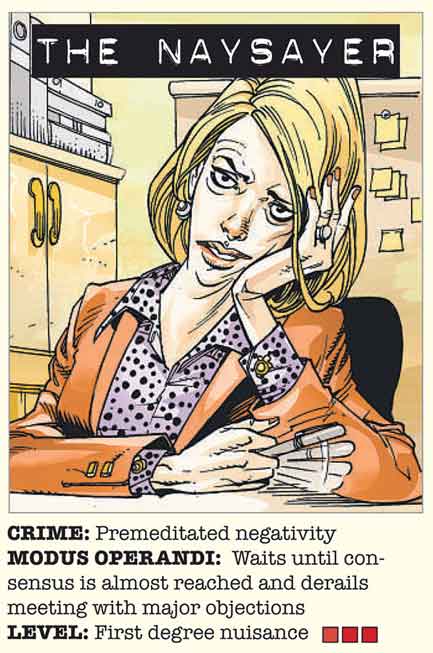
The "Naysayer" - image courtesy of the Wall Street Journal

The naysayer - the person who thinks nothing is ever possible ... ever. The one who is quick with the reasons why something will not work -- without have any creative suggestions for how to solve a problem. Favorite sentence starters for the naysayer:
- "That won't work because ..."
- "We tried that a few years ago and ..."
- "There's just one thing ..."
- "No, that'll never fly." (note: "fly" = work)

The nitpicker - the person who finds fault or problems with everything. The reason they find problems with everything is that they look hard for them! No problem is too small to identify and complain about! This word is featured in the book Speak Better Business English and Make More Money. Its origin comes from picking nits out of hair or fur (nits are the little eggs of parasitic insects).

The "Rambler" - image courtesy off the Wall Street Journal 
The rambler - this is the person in the office who does not know when to stop talking. Blah, blah, blah, as we say in American English, to express that someone is talking for too long. We can also say, "He goes on and on." This person seems to get most active when you're either trying to head out for your lunch break, or trying to leave your office by 5 p.m. Most of the information provided by the Rambler is: (a) stuff you either already know (perhaps because he's told you before, then forgot) or (b) you don't really care about. Ramblers I've known are not sensitive to small cues or body language. So they keep talking, even as you get up from your office chair and head for the door.

The control freak - this person spends every moment trying to control everybody else. How do they get their own work done? They don't. They think of it as their job to control what you and everybody else is doing. Think you're going to make a quick trip to the bathroom without anybody noticing? Think again!

The micro-manager - a relative of the nitpicker (see above). No tiny detail is too small for this person to worry about. She'll spend hours re-ordering the lists in your PowerPoint. He or she manages every single detail. The people working for her/him will often start to feel dumb, powerless, and resentful. But most micro-managers won't pick up on those feelings.

The bad apple - this is the person in the office who never should have been offered a job. Sometimes he or she is also called the "rotten apple." They create trouble everywhere. They talk behind people's backs and stir up trouble. They are the basis for the proverb: "One bad apple can spoil the whole bunch." In other words, this person can turn other people in the office -- good people -- into bad ones (by spoiling their morale, creating a bad atmosphere, etc). I don't know how such a wholesome fruit as the apple got to be part of this negative expression!

* you gotta love 'em - this American English expression means just the opposite of what you might think: you will NOT love them because they are annoying. So it is used mainly in an ironic way.

P.S. We've just learned of a company in the state of Utah, USA that sells coffee mugs based on annoying personality types! You know the old saying: "Only in America!" They've got a fine list of annoying personality types along with some funny pictures. Check it out here if you want a good laugh.


Thursday, May 31, 2012

Want to learn American slang?

The Wall Street Journal ran a great article on learning American slang in yesterday's newspaper. You can read it online here.

The article interviewed American idioms and slang expert, Amy Gillett, author of the Speak English Like an American series. Here is Amy's full list of the trickiest slang for non-native speakers to learn and her commentary on what makes this slang tricky? Have tricky slang of your own to suggest? Post it as a comment!

The top five most dangerous/hard-to-use/confusing slang words for English language learners:

What’s up? / Whassup? / Sup? – When this gets stripped down to its shortest form (‘Sup?) it can be hard to understand. It’s also hard for non-native speakers to know how to answer.  They need to learn the acceptable replies (not much, nothing much) instead of replying “fine,” “good,” or “okay.”
  
Shut up! – this term can be tricky to use and to understand because it’s meaning depends on intonation. If you say it as a standard command without a smile, it is clearly rude. If you say it with a smile and rising intonation, it could mean “I don’t believe you” or “Really? Tell me more.”  Or if you stress the “shut” and stretch it out, it could mean, “No way!” or “That’s hard to believe!”  Confusing? You betcha!

hook up  – this term can mean anything from making out to having sex. Non-native speakers are always heartened to learn that native speakers don’t really know what it means either.  Non-native speakers need to be careful not to include it in any kind of romantic overture. Invitations to native speakers along the lines of “Hey, Ashley, want to hook up?” are to be avoided.

the “f” word – this word is tempting for many non-native speakers to sprinkle into their sentences for emphasis, just like many native speakers do. But non-native speakers sometimes overuse it out of enthusiasm or use the wrong article in front of it, as in: “What a f____!” instead of “What the f____!” Non-native speakers are also more likely to put it in writing, not fully appreciating its shock value.

lego – this term, popular on college campuses, is confusing for non-native speakers hearing it for the first time. No, we’re not talking about plastic interlocking toys. It’s slang for “let’s go” and was popularized by rappers.

Wednesday, May 9, 2012

The Favorite "Hot" American Word

I just found out about an organization called the "American Dialect Society" that selects an English Word of the Year
every year. According to its website: "The words or phrases do not have to be brand new, but they have to be newly prominent or notable in the past year." Those selecting the word of the year include linguists, grammarians, professors, writers and editors.

The most recent Word of the Year (WOTY) is "Occupy." According to Ben Zimmer, chair of the New Words Committee of the American Dialect Society, “It’s a very old word, but over the course of just a few months it took on another life and moved in new and unexpected directions, thanks to a national and global movement.” Yes, that would be the Occupy Wall Street movement, which went from occupying Wall Street to occupying cities and town around the entire USA and onto the rest of the world. In this case, the fourth definition of occupy given by Dictionary.com is the most fitting: to take possession and control of (a place), as by military invasion. Maybe with the Occupy movement, this meaning of the word will move up a notch or two!

Lots of other great words were under consideration for the Word of the Year. Here are three of my favorites (and I encourage you to try these out):

1) humblebrag - expression of false humility, often by celebrities on Twitter (Note: "Humble" means when somebody is modest and "brag" is when you say great things about yourself -- put them together and you have false modesty). Here's a great humblebrag example I found on Urbandictionary.com: "I can't believe I sounded like such a idiot on TV last night"

2) FOMO - acronym for “Fear of Missing Out,” - as in, you might miss out on a great party if you decide to skip it. A very nice expression for the mobile phone age because it's short and easy to type and expresses just that feeling you have sometimes when you don't really feel like doing something, but you worry that you will miss something good if you don't do it.

3) artisan, artisanal - term used to describe gourmet food and other products. The folks at American Dialect Society call it a "faux-fancy" term, which I like. It's the kind of adjective you can stick in front of a loaf of bread at a Farmer's Market and then double the price. Or try it out in front of "pizza" as Domino's Pizza is doing for their new fancy "Artisan Pizza" which sells at a premium to its standard pizza. I have also run into "artisanal cheese" recently. It was really expensive, apparently because somebody lovingly made it by hand, in small batches. I think I saw small specks of mold on it too, but maybe that was supposed to add to its charm and "artisanal" quality!

"Occupy" was the Word of the Year in 2011. Of course, there is going to be another WOTY in 2012. We can only guess now at what English word or expression might rise to the top of the pile and occupy next year's place of honor!

Wednesday, February 15, 2012

Chinese Fakes Give Us A Chance to Learn Real English

Copies of Western brands are all over China. Of course, Western companies are upset to be competing with these fake products, also called "knockoffs" and sometimes referred to as "counterfeit." According to a new article in the Wall Street Journal ("Chinese Shoppers Lose Taste for Fakes" by Laurie Burkitt), Chinese consumers are starting to pass up these knockoffs and choose the real thing instead! Even if it means paying a lot more money. Let's read part of this newspaper article and then study some of the expressions in it. Words and expressions we'll study are highlighted in bold below:

------------

Even as foreign companies and the White House pressure China to crack down on fake products, consumers like Liu Wenzhong are showing the nation's growing taste for the real thing.

At a North Face sports-apparel store in one of Beijing's most popular shopping districts, Mr. Liu recently bought a pair of snow boots and a fleece hoodie. At around 700 yuan, or roughly $110, each, they are nearly five times the price of counterfeit versions sold down the street.

"The difference of buying real and fake products is how you feel after," says Mr. Liu, a 36-year-old who runs his own fiber-optic-technology sales business and has a steady income of around 15,000 yuan a month. "I can wear a label I've paid for and feel proud."

While knockoff versions of real products still are widely available around China, Mr. Liu's comments indicate a change in shopper attitudes in a country where black-market purchases once were preferred by shoppers...

The shift has fueled the expansion plans of foreign companies in China. Such retailers as Nike Inc., Columbia Sportswear Co., cosmetics maker Shiseido Co. and North Face parent VF Corp. are opening stores in farther-flung Chinese cities. Many retailers are offering special in-store events and other enticements to get shoppers in their stores. And some have adopted measures, such as special packaging, to differentiate their products from fakes.

"Consumers in China are even more discerning than their counterparts in the Western world," says Aidan O'Meara, president of VF's Asia-Pacific division. "They don't want to be caught dead with a fake product."
---

Okay, now it's time to study some of the words and expressions from this article:

crack down on - to start enforcing rules more; to restrain. (Yes, we all know that these fake products filling the streets and stores in China are not legal, but in the past, there haven't been huge efforts to crack down on the fakes).

knockoff - a copy; a fake. Sometimes knockoffs are so good, you can't tell them apart from the real thing.

farther-flung - even farther than "far flung" - which means far from the center; in a remote or distant area. Far flung cities would be those not near one of the big capitals. "Farther" is the comparative form of the word "far". Far - farther- farthest.

enticements - things that attract people. In this case, store owners are offering enticements to get people to come into their store -- to lure them in and get them to start shopping.

(to) differentiate - oh, this is such a critical marketing term! This means to make your product or service different from those of your competitors.

don't want to be caught dead with - don't try to understand this idiom word for word! It has nothing to do with being alive or dead. It means something someone absolutely does NOT want. In this case, Chinese consumers do not want to be seen with a fake product (or at least one that others recognize as a fake).

Want to learn more Business English? Check out Speak Better Business English and Make More Money, a new book and CD to help you improve your Business English. There's an entire lesson in that chapter dedicated to knockoffs!

Wednesday, December 15, 2010

Improve your Business English with some Tech Talk

Just when you thought the $99 laptop was around the corner...the Wall Street Journal reports that the costs of PCs (personal computers) is going up. Read these exerpts from their article of December 14 by Ben Worthen and then we'll review some key business English expressions. The expressions we will focus on are in bold.

Rising Computer Prices Buck the Trend

For the first time in several years, people shopping for personal computers are doing something new: paying more.

Computer prices are rising even as the prices of other consumer electronics such as high-definition televisions and digital cameras plunge this holiday season.

In November, the average retail price of a PC sold in the U.S. was $615, up 6% from last year's $580...

The rising prices for PCs...is a stark turnabout for the $250 billion global PC industry, which for years has coped with sharp price declines even as machines became more powerful.

The cut-throat pricing of recent years has rippled through the industry, squeezing profit margins for big PC makers such as Hewlett-Packard Co. and Dell Inc...

The higher-end models are "flying off the shelves," said PaulHenri Ferrand, chief marketing officer for Dell's consumer unit.

---------
Now let's discuss the terms in bold:

buck the trend - to go against the direction things were moving; to be an exception to the rule (NOTE: This term is often used in investing. A company whose stock is "bucking the trend" is going up while the overall stock market is going down.)

plunge - to go down by a lot; to sink. Often said of prices or demand.

to cope with - to deal with something bad

cut-throat - very competitive. Often used with the word competition, as in: The cut-throat competition in the PC industry has led to lower prices OR Joe faced cut-throat competition to gain admission to Harvard Business School).

to ripple through - to travel through, as in a wave; to move through (think of waves rippling through an ocean).

to squeeze profit margins - to make profit margins go lower (profit margins show how much a company is earning). A company wants profit margins to be as high as possible (more $$$ for the executives!) so when they are squeezed, it's a bad thing.

to fly off the shelves - to be very popular; to sell very well (Imagine products with little wings flying through the air of the store, headed to the cash register). This idiom is featured that way in More Speak English Like an American, which teaches 350 American English expressions and is part of the bestselling Speak English Like an American series.