Showing posts with label business expressions. Show all posts

Friday, July 10, 2020

Learn English Online: How to Make Suggestions in English

There are many ways to make suggestions in English. Here are three of the most common ones. Why don't you try them out in your next English conversation? 

1) Why don’t we / you / I + base form of the verb*


• Why don’t we stop paying our office lease and just work from home?

• Why don’t I drive you to the airport on Friday?

• Why don’t we find a new supplier for our packaging?

• Why don’t we have a Zoom chat on Thursday at 9?

* Note: The base form of the verb is the verb without any endings. Examples of verbs in the base form are: run, eat, play, go, find

2) How about + -ing form of the verb


• How about letting our employees work from home as often as they want?

• How about requiring all of our customers to wear masks?

• How about giving all of our employees a generous holiday bonus?

3) Let’s + base form of the verb


• Let’s brainstorm ideas for new products.

• Let’s work on the project tomorrow.

• Let’s wait and see what happens before hiring any new employees.

• Let’s not plan any international travel for the next year.


If you find this content useful, be sure to check out our online English courses. Register at English Academy and get the first lesson of each course free! 


Tuesday, February 26, 2013

Let's Learn Some Business English with a Story about Jesus (the Brand)

An advertisement for Jesus Jeans
(It looks like this model could have 

gone for the next size up!).
No, this is not going to be a post about religion. It's going to be a post to help you improve your Business English (and your legal English). But we are going to be talking about Jesus today. That's because an Italian clothing company has trademarked the name "Jesus" and uses it on its Jesus Jeans. It's now fighting with other clothing companies trying to use the name Jesus too.

In conversational English we sometimes say "Jesus!" to express anger or outrage (or the shortened "Jeez!"). Some of the people in the newspaper article we are going to look at today are definitely saying "Jesus!" They are very unhappy that one company is not sharing the "Jesus" name. Who would have though that dozens of clothing companies would choose "Jesus" as their brand name? And then start fighting about it? All of this is not in the spirit of Jesus himself, but it does make for interesting reading (and English study!).

Let's take a look at the newspaper article, which is entitled "If You Take These Jeans' Name in Vain, Prepare to Meet Their Maker" and is from the Wall Street Journal. The expressions we will study are in blue.

Inspired by his time leading a singles ministry in Virginia Beach, Va., Michael Julius Anton came up with an idea for a clothing line that he thought was catchy and unique—"Jesus Surfed." He was on good ground with "Surfed." But when he went to register the trademark, he found someone had beaten him to Jesus.
In a branding coup of biblical proportions, an Italian jeans maker persuaded the U.S. Patent and Trademark Office in 2007 to register the word "Jesus" as a trademark, giving the company exclusive rights in America to sell clothing bearing the name of Christianity's central figure.
Since then, the owner of the trademark, Jesus Jeans, has clamped down on Jesus-themed apparel, pitting its litigators against more than a dozen other startup clothing lines it claims appropriated "Jesus" without the company's blessing. The company doesn't have a trademark on images of Jesus, just the word.
Before taking on Jesus Surfed, Jesus Jeans objected to "Jesus First," "Sweet Jesus," and "Jesus Couture," among others, which abandoned their trademark efforts. In some cases, when met with resistance, Jesus Jeans warned that it could sue for damages.
Now let's look at the definitions of vocabulary:

(to) come up with – to think of

catchy – memorable, appealing (Note: You will often heard the phrase "catchy tune," meaning a song or melody that stays in your head and is fun to sing, though eventually it might drive you crazy)

on good ground – safe with (Note: this terms first appeared in the Bible, which is probably why the author of this newspaper article chose to use it in a story about Jesus: Here is a quote from Luke 8:15, King James Bible: But that on the good ground are they, which in an honest and good heart, having heard the word, keep it, and bring forth fruit with patience.)

(to) register a trademark – to formally register a symbol (name, logo, etc) for a product with a governmental patent office (in the USA, with the United States Patent and Trademark Office, USPTO)

(to) beaten someone to – to do something before somebody else has a chance (in this case, Jesus Jeans beat Jesus Surfed to register the "Jesus" trademark)

of biblical proportions – great; having big consequences; large in scope (Note: This often refers to natural disasters -- Example: A wildfire of biblical proportions swept through California and destroyed hundreds of houses). Biblical is the adjective form of Bible, so here we have a play on words.

(to) clamp down on – to get strict about

(to) pit someone against – to put someone up to fighting someone or something

blessing – two definitions (which is what makes this word choice another play on words here): 1) approval and 2) a favor or gift bestowed by God (Note: there are some other definitions of this word also)

(to) meet with resistance – to face one's objections to something 

(to) sue for damages – to take someone to court and try to get money (or other compensation) from them for harming one's business

Tuesday, February 12, 2013

I Love Business English: in Honor of Valentine's Day

Pam and Jim from the Office. An example of a
successful office romance.
In honor of Valentine's Day, I've chosen an article on workplace romances to help you improve your Business English. Ahhh, the workplace romance. We all have stories of love at the office. I remember when an old boss of mine disappeared for several days in Europe immediately following an official business trip. Coincidentally, a young assistant at the office was also in Europe for those same three days!

An old friend of mine fell in love during a summer internship. She ended up leaving her husband. The man she fell in love with left his wife. They now have children and are, as far as I know, happily married. So sometimes the office romance does end happily (even when it starts out as "an affair," because one or both of the love-birds is married).

Now, let's get down to business and look at our article for today. It's called "When Cupid Visits the Office, Rules Can Cut Risks" and it is from the Wall Street Journal. We will look at an extract from the article first, with words and phrases to study highlighted in blue.
Companies by now are well-acquainted with the hazards of workplace romance. But, if recent incidents are any indicator, they still find it tricky to put a lid on office passions.
Some companies have attempted to regulate the romantic sparks that fly between co-workers, mindful of the potential legal fallout.
Still, even the best-crafted rules can't guard against workers who follow their instincts instead of consulting the employee handbook.
Inappropriate relationships can topple careers, and allegations of unwanted attention or favoritism can cost companies millions of dollars and land businesses in the headlines for all the wrong reasons…
Lawyers say companies that do lay out ground rules for dating may be able to head some lawsuits off at the pass—or at least curb corporate liability should matters end up in court.
"It's not just about warding off or fending off a claim of harassment. You also don't want to create the kind of environment or perception that that's a way to get ahead," said David S. Baffa, an employment lawyer and head of the workplace-compliance practice at Chicago law firm Seyfarth Shaw LLP.
Now let's look at the highlighted words and phrases:

(to) put a lid on – to stop; to stop something from increasing. This is often used to discuss spending. For example: Expenses are getting out of control. We need to put a lid on spending.

sparks fly / make sparks fly / when sparks fly – this refers to the reaction between two people. Here, the reference is to "romantic" sparks -- in other words, two people attracted to each other. Taylor Swift has a popular love song called "Sparks Fly" (¯Sing it: 'Cause I see sparks fly whenever you smile'¯). Also, note that the sparks flying can refer to anger between two people. For example: Doug and Marie disagree on everything. If they're both at the meeting, sparks will fly.

fallout – consequences; bad results of a situation (in this case, the "legal fallout" refers to the lawsuits or legal troubles that may happen following an unsuccessful office romance)

(to) topple – to cause to fall (in both the figurative and the literal sense: when you stack blocks on top of each other and the tower gets tall, you put one more on and the whole thing topples over).

ground rules – basic rules; rules that everybody should be know and follow (Note: I've never worked at a company that laid out the ground rules for dating. All the employee manuals I've seen are pretty boring -- how many days in advance to ask for a vacation day, insurance policies -- nothing so interesting as How to Behave if You've Fallen in Love with a Co-worker).

head something off at the pass – to stop something from happening (in this case, to stop a lawsuit from happening).

(to) curb – to reduce (This verb is also often associated with spending.Example: Money is tight. We need to curb spending).

(to) ward off – to stop something from happening; to hold something off (This phrasal verb is often associated with illness. Example: Many people at my office are sick right now. I'm doing my best to ward off illness).

(to) fend off – to stop something from happening (Note that this is very similar in meaning to "ward off").

(to) get ahead – to advance in one's career (Yes, one way to get ahead may be to become romantic partners with the right person in the organization -- but the lawyer in this article says the company should not create an atmosphere where people think that).

Y I hope you've enjoyed this Valentine's Day lesson. If so, check out More Speak English Like an American, which is full of more useful idioms and vocabulary for Business English. And office romance, too!

Thursday, June 7, 2012

American Business English - Learn How to Name Your Colleagues!

A Short Field Guide to American Workers (Part One)

Your American colleagues and co-workers ... you gotta love 'em.*  Or not. If not, you can have lots of fun figuring out how to categorize them. Here are a few types of office workers that are universal (at least in the USA -- maybe other countries have their own typical office worker types): 

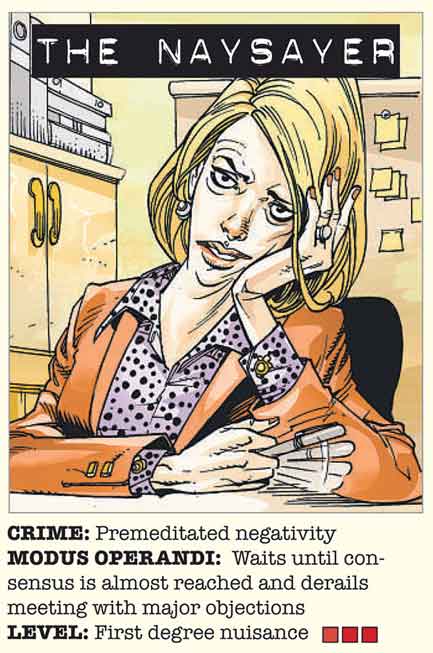
The "Naysayer" - image courtesy of the Wall Street Journal

The naysayer - the person who thinks nothing is ever possible ... ever. The one who is quick with the reasons why something will not work -- without have any creative suggestions for how to solve a problem. Favorite sentence starters for the naysayer:
- "That won't work because ..."
- "We tried that a few years ago and ..."
- "There's just one thing ..."
- "No, that'll never fly." (note: "fly" = work)

The nitpicker - the person who finds fault or problems with everything. The reason they find problems with everything is that they look hard for them! No problem is too small to identify and complain about! This word is featured in the book Speak Better Business English and Make More Money. Its origin comes from picking nits out of hair or fur (nits are the little eggs of parasitic insects).

The "Rambler" - image courtesy off the Wall Street Journal 
The rambler - this is the person in the office who does not know when to stop talking. Blah, blah, blah, as we say in American English, to express that someone is talking for too long. We can also say, "He goes on and on." This person seems to get most active when you're either trying to head out for your lunch break, or trying to leave your office by 5 p.m. Most of the information provided by the Rambler is: (a) stuff you either already know (perhaps because he's told you before, then forgot) or (b) you don't really care about. Ramblers I've known are not sensitive to small cues or body language. So they keep talking, even as you get up from your office chair and head for the door.

The control freak - this person spends every moment trying to control everybody else. How do they get their own work done? They don't. They think of it as their job to control what you and everybody else is doing. Think you're going to make a quick trip to the bathroom without anybody noticing? Think again!

The micro-manager - a relative of the nitpicker (see above). No tiny detail is too small for this person to worry about. She'll spend hours re-ordering the lists in your PowerPoint. He or she manages every single detail. The people working for her/him will often start to feel dumb, powerless, and resentful. But most micro-managers won't pick up on those feelings.

The bad apple - this is the person in the office who never should have been offered a job. Sometimes he or she is also called the "rotten apple." They create trouble everywhere. They talk behind people's backs and stir up trouble. They are the basis for the proverb: "One bad apple can spoil the whole bunch." In other words, this person can turn other people in the office -- good people -- into bad ones (by spoiling their morale, creating a bad atmosphere, etc). I don't know how such a wholesome fruit as the apple got to be part of this negative expression!

* you gotta love 'em - this American English expression means just the opposite of what you might think: you will NOT love them because they are annoying. So it is used mainly in an ironic way.

P.S. We've just learned of a company in the state of Utah, USA that sells coffee mugs based on annoying personality types! You know the old saying: "Only in America!" They've got a fine list of annoying personality types along with some funny pictures. Check it out here if you want a good laugh.


Monday, March 5, 2012

LinkedIn Founder Will Teach us Some Business English: Talk Like a Successful American Entrepreneur!

Reid Hoffman is the co-founder of the company LinkedIn. As the Wall Street Journal discusses in a recent article and interview with him, he's also an investor and/or advisor to many other big tech companies. Now he's searching for the next "breakout idea". What's a breakout idea? One that is a very new idea that will form the basis of a very successful new product, service, or even entire company. Let's look at some of the Wall Street Journal's interview with Reid Hoffman, and we'll see his use of business idioms in action! Expressions we'll discuss are in bold. Today, we'll be exploring three great business expressions. At the end of this post, watch the video of Mr. Hoffman discussing his plans.

WSJ: Why is LinkedIn continuing to experience strong growth in a global recession? How long can the company keep it up?

Mr. Hoffman: In either an up or down economy, business proceeds. That is one of the reasons LinkedIn, in up and down economic circumstances, has continued to have good progress. I've been very pleased with Jeff as a CEO, the executive team has been firing on all cylinders. So far I don't see any negative indicators.

(to) fire on all cylinders - to operate as effectively as possible; to be running very well.

-------
WSJ: Facebook CEO Mark Zuckerberg has said he wants to reach 1 billion users. Do you have a similar goal for LinkedIn?

Mr. Hoffman: Ultimately the goal is to be the professional network of the world. It isn't just white-collar. It could be an executive assistant or a small-business owner. It is about improving what you are doing. Maybe that is roughly a quarter of the population of the world, and there are 7 billion people in the world

white-collar - office workers (those whose jobs do not typically involve manual labor or the wearing of uniforms - those jobs are called "blue collar"). If you work in a cubicle or nice office and the main way you get your hands dirty is the mustard you get on your hands while you eat your lunch, you are most likely a "white-collar worker" - this is for sure LinkedIn's current main audience, though we know from this interview that Reid Hoffman would like to expand beyond that

------
WSJ: You've just written a book, "The Start-up of You." What's the take-away?

Mr. Hoffman: Every individual needs to think about themselves as the entrepreneur of their own life. Do you invest in yourself? How do you establish good plans and strategy? How do you take intelligent risk? How do you adapt to the future? You don't do that, you are at serious risk.

take-away - the point; the thing you are supposed to get from reading something, watching something, or hearing a lecture. This is a very popular term in MBA programs around the world. Business school students read business cases. Then they discuss the "take-aways." Sometimes after a business school lecture, business professors will discuss the take-aways from the lecture as review. This helps for students who were sleeping during the entire lecture -- if they wake up and pay attention at the end of class, they can still get their take-aways.

For more great business expressions, check out Speak Better Business English and Make More Money and Speak Business English Like an American. Also, visit the iPhone and iPad apps Speak Business English I and Speak Business English II on iTunes.

Watch the video of Reid Hoffman discussing LinkedIn and improve your English. Listen for when he says "the need to stay on top of an industry." "Stay on top" is another business idioms - it means be aware of the newest things going on or keep your knowledge fresh. What other interesting things do you hear him say?:

Tuesday, February 28, 2012

Think Outside the Box Is Not Just a Tired Business Idiom

Have you heard the expression think outside the box? It's a popular American

English business idiom and it means that you should think creatively about something. It also happens to be one of the business idioms I teach in my book "Speak Business English Like an American" (and I note that is now overused so you might not want to use it yourself -- but you will certainly hear it being used).

According to new research covered in a New York Times article "When Truisms are True", it really DOES help your creativity when you think outside the box. Business school professors performed an experiment on 102 students at New York University. They gave them a creative task - the students were told to think of a word that was associated with three other words (example: given the words measure, worm, and video, the students would give the answer tape). Some students were put in a 125-cubic-foot box made of plastic and cardboard to do the task. Others did the task while seated just outside the box. Guess which group performed significantly better? Those sitting OUTSIDE the box. They thought of 20% more creative solutions than the box folks. So thinking outside the box is not just a metaphor -- it can also be taken literally.

What implications does that have for those who work in cubicles? Get out of your box from time to time and do some thinking outside the box!

Two more business idioms proven to have powers by this research team: on the one hand/on the other hand. Are you familiar with this structure? Use it like this: One the one hand, I'd like to take the job in Russia. On the other hand, I'm very comfortable living and working here in the United States." When students were asked to come up with fresh ideas, the students who were told to generate ideas while using both hands (and switching between them) did better. They came up with MORE ideas than those students who only listed there ideas using one hand. Too bad the expressions aren't "On the one finger / on the other finger" - we'd have 8 more appendages to work with in generating creative ideas!

Check out the full New York Times article by clicking here
.

Monday, October 31, 2011

Companies Aren't Getting Employees They Need - but We'll Get the English We Need!

The unemployment rate in the USA is 9%. That means lots of people are out there looking for work. Meanwhile, companies are complaining that they cannot find enough skilled worker. A recent Wall Street Journal article discussed this situation -- and it was full of great business English terms for us to study!

We will study part of the article, entitled "Why Companies Aren't Getting The Employees They Need" and written by Peter Cappelli. Idioms and expressions we will examine are in bold:

Even with unemployment hovering around 9%, companies are grousing that they can't find skilled workers, and filling a job can take months of hunting. Employers are quick to lay blame. Schools aren't giving kids the right kind of training. The government isn't letting in enough high-skill immigrants. The list goes on and on. But I believe that the real culprits are the employers themselves. With an abundance of workers to choose from, employers are demanding more of job candidates than ever before. They want prospective workers to be able to fill a role right away, without any training or ramp-up time. In other words, to get a job, you have to have that job already. It's a Catch-22 situation for workers ...

To get America's job engine revving again, companies need to stop pinning so much of the blame on our nation's education system. They need to drop the idea of finding perfect candidates and look for people who could do the job with a bit of training and practice. There are plenty of ways to get workers up to speed without investing too much time and money, such as putting new employees on extended probationary periods and relying more on internal hires, who know the ropes better than outsiders would.

Now let's improve our English by studying some of the terms and expressions used above:

(to) grouse - to complain (a colorful way to say to complain, implying that there is not much basis to the complaint and the person doing the grousing would be better off closing his trap - or mouth - and doing something to improve the situation!).

(to) lay blame - to put the blame on somebody or something else. In English, we don't "give" blame, rather we "lay" it.

(to)go on and on - to continue (like this phrase because the repetition of "on" reflects the situation). We often use this phrase when talking about somebody who doesn't know when to shut his trap - or mouth. Example: "He went on and on at the meeting about what a great job he did. I thought he'd never be quiet."

ramp-up time - time needed to learn how to do a new job well.

Catch-22 situation - a frustrating situation in which one cannot do anything because the thing one needs to take action is the very thing one does not have (in this article, the person who needs a job must already have a job to get a job). Interestingly, the expression Catch 22 comes from a book with that title by the author Joseph Heller.

to pin blame on - to say it's somebody' fault. Okay, so we don't just "lay" blame as above, we also pin it on somebody else. Why so many ways to assign blame in English? Well, I guess we do a lot of blaming in our culture!

get someone up to speed - to train somebody so they know how to do their job well.

to know the ropes - to know how to get things done in a job; to know how things at a company run. This idiom comes from the world of sailing. To be a good sailor, you need to know how to work the ropes. You will also hear the related expressions: "to learn the ropes" meaning to get to know how to do a new job.

Want to keep improving your Business English? Check out Speak Business English Like an American and Speak Better Business English and Make More Money.

Wednesday, October 27, 2010

Halloween Costumes Sure to Scare and Some Business English Too

Have you ever heard of Snooki? I hadn't until recently when I found out that the Snooki Halloween costume is a bestseller this year. So who is Snooki? She's a character on the MTV show "Jersey Shore." She has big hair and she wears a short leopard dress.

According to a Wall Street Journal article: "Costumes based on Snooki's poofy hair...have been flying off store shelves."

Time to break for some vocabulary:

poofy hair - big hair that usually goes high up in the air before settling down again (not a compliment)

flying off the shelves - this is a great idioms that means to sell very fast. Another idiom that means the same thing is: to sell like hotcakes.

Snooki's costumes are flying off the shelves so fast, some shelves are now empty of Snooki wigs. According to the Wall Street Journal:

Retailers who are selling out of the official Pauly D Snooki wigs and other authorized wear are coming up with makeshift Jersey Halloween packages.

in a pinch, they're finding that they can put together a pretty good Snooki kit with skin bronzer, furry pink slippers, and one of last year's unsold Amy Winehouse wigs...

A return to Business English vocabulary:

makeshift - something made up to meet an urgent need; something put together quickly because it's needed

in a pinch - in a difficult situation, when no other options are available (You can hear the store owner yelling in desperation: "Oh no! We ran out of official Snooki wigs. Time to get out the old Amy Winehouse wigs...Maybe nobody will notice").

Happy Halloween! If you want to learn more business expressions, give yourself a TREAT and buy yourself a copy of the new book/audio CD "Speak Better Business English and Make More Money."

Thursday, July 16, 2009

This iPhone Story Has Some Great Business Idioms!

It looks like iPhones are creating lots of opportunities for small businesses. It is also creating an opportunity for us to review some great business English expressions. And speaking of using phones to learn English, has anybody out there found any useful apps (applications) for learning English through their mobile phone or smartphone? If so, please post a comment!

The following is the beginning of an article from a Wall Street Journal article entitled "Seeking Fame in Apple's Sea of Apps." Phrases to be discussed are in blue. Reminder to check out the bestselling book & audio CD set "Speak Business English Like an American" for more useful business English expressions.

Apple Inc.'s App Store has spawned a cottage industry of software developers trying to profit from games and other applications that people can download onto their iPhones.

But with more than 65,000 free and paid applications in the online store, success has hinged on an app's ability to stand out. So developers are increasingly coming up with various strategies to make a splash, employing everything from temporary discounts to guerilla marketing tactics.

cottage industry - a small-scale industry; a market in which the competitors are individual or very small companies and often operation out of their homes (hence the "cottage")

profit from - make money from

hinged on - depended on

stand out - rise above or grab more attention than the competition

make a splash - become an immediate success; make a big impact

guerilla marketing - marketing tactics that do not require much money but do require time and imagination; unconventional or unusual ways to market a product or service (often used by small companies because they cannot afford large advertising budgets)